



The Working Time Directive (WTD) break rules are simple in principle, but easy to misunderstand in practice.
Most infringements do not happen because drivers deliberately skip breaks.
They happen because drivers misunderstand when breaks must be taken and what counts.
This page explains the 6-hour and 9-hour Working Time break rules accurately, using wording that reflects how enforcement assesses them.
Drivers’ hours rest rules are covered separately.
WTD Break Rules – Key Points
-
WTD is based on Working Time, not elapsed shift time
-
You may reach 6:00 or 9:00 of Working Time
-
You must not exceed those points without the required breaks already taken
-
Each break must be at least 15 minutes
-
Over 6 hours of Working Time → 30 minutes total breaks required
-
Over 9 hours of Working Time → 45 minutes total breaks required
-
Only breaks count
-
POA does not count
-
Breaks reset the Working Time break requirement
This is why a long shift can be compliant, and a shorter shift can still contain a WTD infringement.
The Core Accuracy Rule
You may reach the limit.
You must not go past it without the required breaks already taken.
6:01 and 9:01 are the no-go points.
Working Time, Not Elapsed Time
WTD break limits are based on how much Working Time has been carried out, not how long the shift lasts.
Only time that legally counts as Working Time is added up.
Time spent on:
-
Breaks
-
Rest
-
Correctly used Periods of Availability (POA)
does not add to the total.
This is why drivers can believe they are compliant based on shift length while still breaching WTD.
The 6-Hour Rule
You must not exceed 6 hours of Working Time without taking a break.
That means:
-
You may reach 6:00 exactly
-
You must not go to 6:01 unless a qualifying break has already been taken
Minimum requirement:
At least 15 minutes of break, taken as one continuous break of 15 minutes or more.
Waiting until after 6 hours and then stopping is already too late.
Critical rule
A qualifying break must be completed before Working Time reaches the limit.
Taking a break after 6:00 or 9:00 of Working Time does not prevent an infringement.
The 9-Hour Threshold
Break requirements increase as Working Time increases:
-
If Working Time goes over 6 hours, total breaks must reach 30 minutes
-
If Working Time goes over 9 hours, total breaks must reach 45 minutes
You may reach 9:00 exactly.
You must not go to 9:01 unless the higher break requirement has already been met.
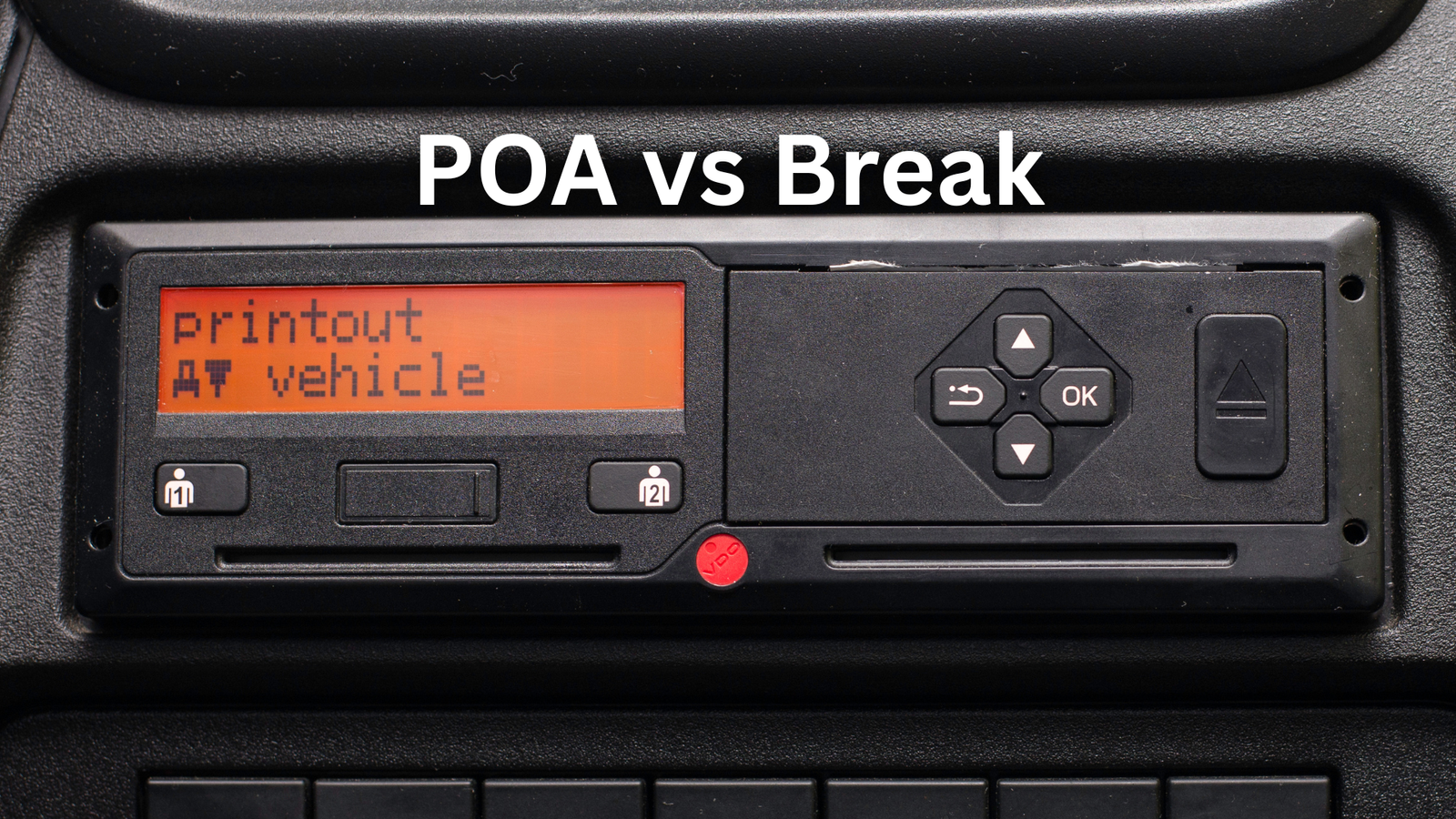
Only breaks count.
POA does not.
POA and Breaks Are Not the Same
Periods of Availability (POA) and breaks are not interchangeable.
-
POA pauses the Working Time clock
-
A break resets the Working Time break requirement
POA is only valid where waiting time is known in advance.
It is not rest, and it does not replace a break.
Incorrect POA use around the 6-hour and 9-hour thresholds is a common cause of hidden infringements.
Company Rules vs Legal Rules
Some operators apply internal rules based on:
-
Elapsed shift length
-
Fixed break schedules
-
Pay systems
These may be more restrictive than the law and are often used for planning or fatigue management.
They do not change how Working Time is calculated under WTD.
Where This Page Stops
This page explains:
-
What the WTD break rules are
-
Where the legal thresholds sit
-
How enforcement assesses compliance
It does not show worked shifts, timelines, or long-day strategies.
Applying these rules to real shifts and records is covered separately in paid training.
Related Guides
← Return to the main guide: Working Time Directive for HGV Drivers – Complete Guide