
The basics of confusion
Confusing a Period of Availability (POA) with a break is one of the most common causes of Working Time Directive (WTD) infringements.
They are not interchangeable.
They do very different things in law.
This page explains the legal difference between POA and a break, how each affects Working Time, and why mixing them up creates infringements.
POA vs Break – At a Glance
Period of Availability (POA)
Pauses the accumulation of Working Time
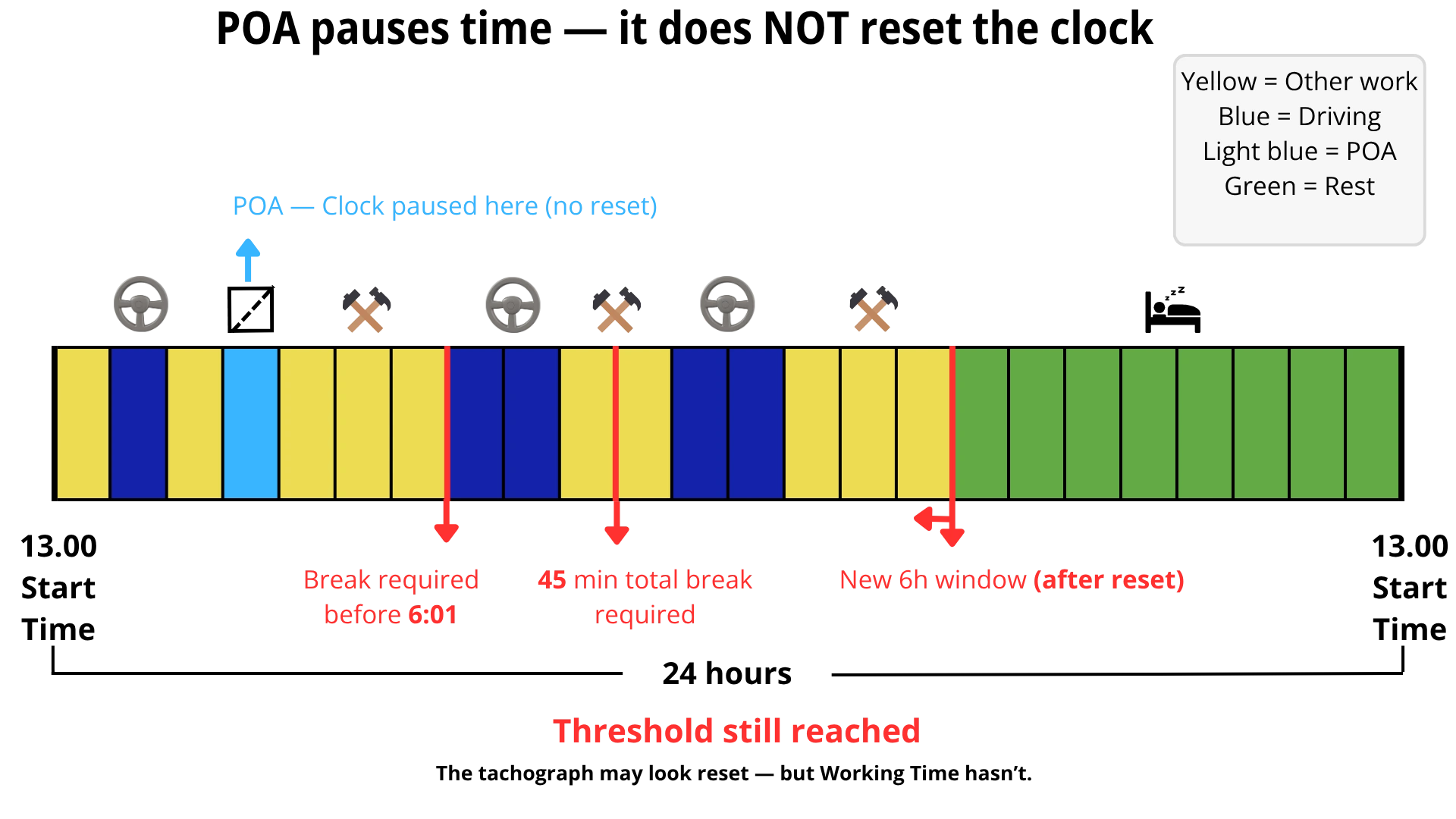
Does not reset the 6-hour Working Time clock
Is not a break
Does not reduce fatigue
Only applies in very specific circumstances
Break
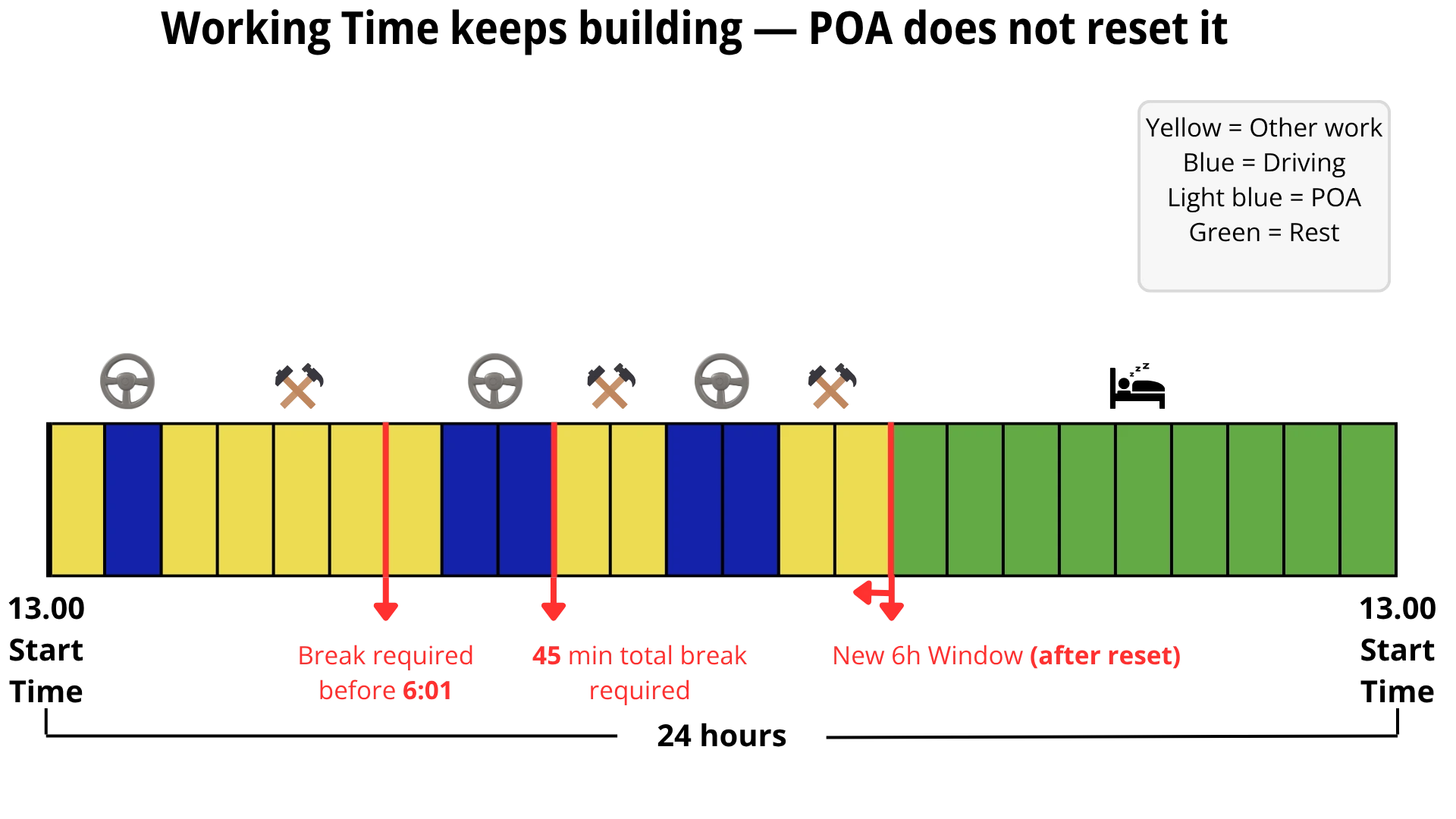
Resets the 6-hour Working Time period
Counts toward the 30 / 45 minute break requirement
Must be at least 15 minutes
Requires complete freedom from work and responsibility
The One-Line Rule
POA pauses the clock.
A break resets it.
What Is a Period of Availability (POA)?
A Period of Availability (POA) is time when a driver is waiting but not working.
POA only applies when all three of the following conditions are met:
You are waiting
The duration of the waiting time is known in advance
You are not responsible for the vehicle, load, or instructions
If any one of these conditions is not met, the time is not POA.
What POA Does (and Does Not Do)
POA does:
Stop Working Time from increasing
Delay when Working Time thresholds are reached
POA does not:
Count as a break
Reset the 6-hour Working Time clock
Replace required breaks
Reduce fatigue
POA exists to stop defined, unavoidable waiting from being counted as work — nothing more.
What Is a Break?
A break is time when a driver is completely free from work and responsibility.
During a break:
No work may be performed
The driver must not be responsible for the vehicle or load
The driver must be free to rest
Breaks are the only thing that reset the 6-hour Working Time period.
Why the Difference Matters
POA and breaks affect Working Time in different ways:
POA pauses Working Time
A break resets it
Using POA when a break is required does not prevent a breach.
Using a break correctly does.
Incorrect POA use around Working Time thresholds is a common cause of hidden infringements.
POA, Breaks, and WTD Thresholds
Under WTD:
You must not exceed 6 hours of Working Time without taking a break
If total Working Time exceeds 9 hours, the total break requirement increases
POA affects when thresholds are reached.
Only breaks satisfy break requirements.
POA never replaces a break.
For full threshold detail, see:
WTD Break Rules Explained (6-Hour and 9-Hour Rule)
Common Misunderstandings
These assumptions frequently cause errors:
“I wasn’t driving”
“I was just waiting”
“I roughly knew how long it would be”
“Transport told me to log POA”
None of these override the legal tests for POA or breaks.
WTD compliance is evidence-based, not intention-based.
Where This Page Stops
This page explains:
What a break is
How each affects Working Time
Why confusing them creates infringements
It does not show worked shifts, waiting scenarios, or recording decisions.
Applying these rules to real shifts and records is covered separately in paid training.
Related
What Is Working Time
Second Jobs, Manual Entries & WTD Explained
Return to the main guide: